

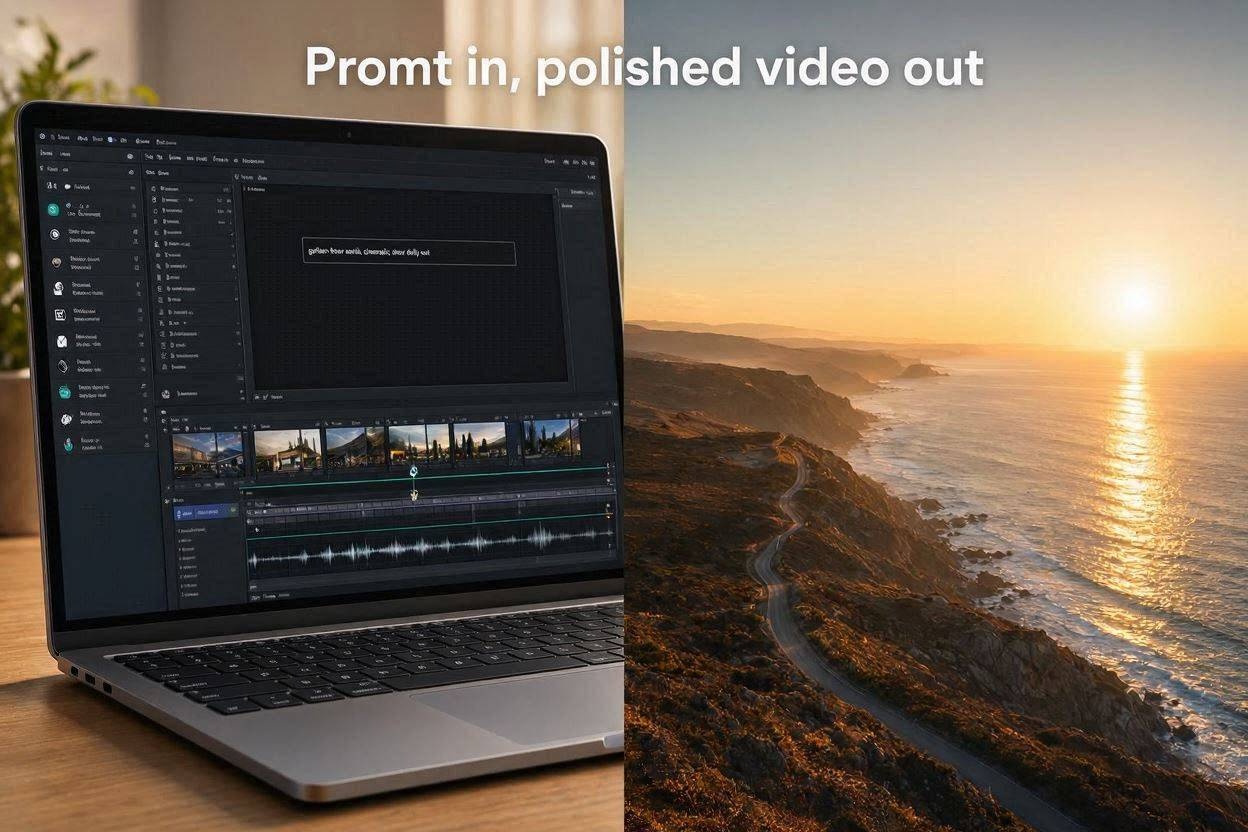
Here’s what I’d pick according to need: • 3.1 Google Veo – Most realistic video & audio • 2.4 Runway Gen-4.5 – Camera-control+VFX. • 5.1Synthesia – talkinghead-only corporate videos • 1,264Kling AI – natural human motion in AI-created video. For now, my no. 1 go-to would be to use a multi model solution
Why Choosing the Right AI Video Generator Matters
Today there are now even AI video generators that significantly shorten those timelines from days of production into minutes-this even for solopreneurs who don’t have the bandwidth or money to hire camera crews, editors, or even purchase top-tier video production equipment for their brands.
But “AI video generator” is no longer a single category of tool – it’s a complete market with profoundly different features. Some companies lean into photorealistic cinematic movements. Some leverage business personas and multiple language voiceovers. Others target high-frequency social posting, and a few act more like mini production suites stacked with editing capabilities, consistency management, and asset organization above the basic video creation.
Choosing the wrong tool costs more than a monthly subscription in time and money. This is measured in waste when the video begins to drift halfway through your clip in unwanted, unforeseen ways, or the hours you waste prompting an AI tool until you’re unable to get the same expression of your desired character’s face on their character’s body. Knowledge is indeed power, especially when comparing AI tools, so familiarize yourself with which tools offer what is not advertised.
Best AI Video Generator at a Glance
| Category | Details |
| Focus | Comparing leading AI video generation platforms by realism, control, pricing, and use case |
| Primary Challenge | Matching the right model/platform to your specific content goal instead of chasing a single “best” tool |
| Best For | Marketers, content creators, filmmakers, educators, and businesses producing video at scale |
| Reading Time | 9–11 minutes |
| Key Benefit | A clear, use-case-based framework for choosing an AI video generator without wasting credits on trial and error |
How AI Video Generators Actually Work
Today most advanced AI video tools utilize what is called diffusion-models; these are large models that were trained on a tremendous corpus of video clips. These tools when given you input (or an image prompt of sorts) guess and generate subsequent motion, audio, and camera movements for each frame of your sequence to correspond to your input.
The distinctions typically come in 3 areas:
- The underlying model. (Each of Veo, Sora, Kling, Seedance, runway’s Gen lines, etc., have individual “signatures”)
- The interface layer was added to that model. (Editing capabilities, consistency controls, library asset functionality)
- Business model. (Per model vs. Aggregators, where you have access to multiple models for a single account price.
Because generators and models aren’t the same things, several of the most capable companies available right now are aggregates-making it easier for you to test run a few models against each other instead of restricting your access to a single engine.
Top AI Video Generators Compared
Google Veo 3.1 – Top pick for realistic motion
Veo 3.1 remains either best-in-class or in the top percentile on nearly every benchmark report comparing realistic motion, physical accuracy, and combined native audio. VEo 3.1 is also one of few models capable of interpreting multiple elements within multi-object scenes–think floating cities, sweeping panning shots, mood lighting– without degrading into visual artifacts during a clip.
Best suited for: filmmakers, advertising agencies and marketers looking to add footage to projects seamlessly. Trade-offs: Higher cost for films on certain platforms which can integrate models individually – you’ll also get the best from very detailed and coherent prompts.
OpenAI Sora 2 Pro – Top pick for longer narrative form
This Sora comes engineered for developing longer narrative sequences that use integrated dialogue and a robust simulated world. When your project relies upon story context over individual flashes of visual genius, this might be a better option for you.
For those looking to make: Narrative projects, experimentation with short films, projects heavy with dialogues. With this comes the disadvantage of, Longer usage means high premium, the access is usually only included with premium user level.
Runway Gen-4.5 – The best tool to manually control
RunwayGen4.5 is the most professional video generation tool available because it can handle detailed editing requirements instead of generating video in a single command. It offers excellent camera and movement controls that allow the user to make an animation anywhere by utilizing its powerful stroke option tool which enables users to isolate anything and move any part of your frame on command. Video makers and SFX creators commonly use their tools.
Best to use it for: A team of editors that want professional grade controls and tools without implementing a complicated node interface; Price: The trial version works using credit, so not good for video productions.
Kling AI 2.6/3.0 – Most realistic human motion
Kling’s strength lies in its photorealism for human avatars as well as incredibly natural human movement and accurate lip-sync-a clear advantage for any action or dialogue-centric content where other tools tend to warble human facial features and limbs.
Best for: Content populated by actual-looking humans, or with tons of dialogue, physical action, or complex choreography. Trade-off: Fully consistent facial features typically require fine-tuning prompts.
Synthesia – Best for Corporate and Training Video
Synthesia comes with photorealistic avatars and multiple languages – it’s not really designed around movie-like background shots. It is the de facto option to use for the bulk of corporate training, onboarding and in-house videos when you simply want a talking head type presentation style video instead of anything else. It’s used to create in-house explanatory training.
Best for: Learning & Development teams, internal company comms, international explainer videos. Drawback: It is not built for film/cinematic style scenes- that’s the role of other products, not Synthesis itself.
6. Multi-Model Platforms (Higgsfield, fal.ai, & Similar)
Instead of putting all your eggs in one basket, creator and aggregator platforms provide you access to dozens-or more-of these various engines (Veo, Kling, Seedance, Wan, and countless more) through a singular, umbrella credit system and account. Why This is Great: Different projects and scenarios demand different models. One model is the best at prompting Following and generating native audio; another has the cheapest per second rate, and another is by far the most cinematic.
Who this is best for: Creative and teams who work in a wide variety of styles and don’t wish to establish six different payment plans. The Compromise: Most monthly credits do not transfer over to the next billing period. Likewise, those in heavy reliance on one, very powerful model, might just be better off using an engine independently for greater financial leverage.
Free and Budget-Friendly Tools (Kapwing, Canva, InVideo, Pictory)
For creators who dont require frontier model-level realism, template-based tools still are the most efficient route from prompt to deliverable. It takes InVideo less than two minutes to take a brief text cue – with relevant stock footage, background music, and voiceover already incorporated – and have it fully rendered as edited video footage. For those of you creating social-focused content on a zero-dollar budget, Canopy and Kapwing offer the best option. (Both come pre-programmed with caption assistance and pre-sets that prioritize accessibility.
Top for: Social media managers, small-scale businesses, anyone that favors efficiency and a gratis price tag to the sublime hyperrealism of a frontier-model video generation process. Downside: You’ll find yourself making a trade-off between freedom of creative choice and visual richness.
How to Choose the Right AI Video Generator for Your Needs
But in most situations, it’s best to “match the tool to the job”:
- If you’re going after cinematic realism for the ads/movies: Look first to Veo or to a multi-model subscription platform which, has it.
- If you want a speaker/avatar for a training video: An avatar-based platform like Synthesia will be superior to cinematic realism models.
- If you’re creating spoken word / human movement / dance: Focus on Kling as its purpose built.
- If you’re generating lots of high volume (and cheaper!) social content: There’s a whole slew of free and template tools out there which will do this better/faster than a premium model.
- Trying to do several of the above: A multi-model package, instead of four separate subscriptions, saves money and access to each of the models individual talents.
Common Mistakes to Avoid
- Chasing “the best” tool is not the best tool for the problem: Generators and models address different problems and ranking them in such a way that they are comparable would lead to frustrations.
- Forgetting the credit economics of models: A premium model could be eating away on the credit’s multiple times faster than an entry-level model – do the calculations.
- Falling for the “free unlimited” claim: A lot of so-called free plans on API’s were a one-time credit allotment. Do not set up a critical workflow around this without verifying.
- Under-prompting complicated scenes. Top tier models favor detail and specificity within the prompt (i.e. Camera movement, lighting, what character is doing), whereas abstract and vague prompts yield generic output no matter the quality of the underlying AI.
- Skipping side-by-side comparison. Identical prompts produce different output across different model outputs – testing both or a handful of different tools on your use-case is far better than sifting through online reviews.
- Neglecting accessibility features. Most ai video generation tools already have preset auto caption and color contrast features – you might as well utilize these instead of coming back and fixing them at a later time.
Key Takeaways
- There’s no such thing as the “best” ai video generator, just the best tool for each job, and knowing how to reconcile those two things is a talent.
- Veo, Sora, Kling, see dance, and the Gen suite on Runway all have a particular visual aesthetic, and should be played around prior to spending anything.
- While multi model offerings can help producers simplify tool kits when they generate multiple types of media, individuals who primarily generate one type of media will likely come up with money saving going direct.
- Avatar-based platforms such as Synthesia do two separate jobs for cinematic generators – choose them on whether you require a presenter or not.
- Free and template-based applications still represent the cheapest and lowest production time, highest quantity, lowest risk method for social media content.
- Generic prompts always underperform the very specific ones for whatever model you choose.
- Credit tics (what rolls over, per model burn rates) are as important as subscription plans.
Conclusion
The AI video generation era has moved beyond “the one for everything” stage. Your best selection is actually the best fit: The photorealism of Veo, the storytelling narrative of Sora, the tight cinematic control of Runway, the physical movement dynamics of Kling, or the speaker focused content style of Synthesia. Better question to answer than “what is best?”… What do I need this next video for and who built the tool to solve for that task?
Frequently Asked Questions
1. What’s the top overall AI video generator to use in 2026?
Overall, Google Veo 3.1 is currently seen as the leading all-around option in terms of photo-realism, movement quality and native audio – however the definition of “best” depends heavily on what you plan to do with the videos.
2. What’s the difference between an AI video generator and an AI video model?
The model (such as Veo or Kling) is the technical part- the “engine” that actually produces the visuals. The generator or platform is the finished product or tool that utilizes that model and typically comes with features like editing options, credits, and often the opportunity to explore several models simultaneously.
3. Are there any truly free AI video generators?
Yes, however, the “free” aspect is generally linked to a single allocation of credits for use at some point, not an ongoing free plan. Both Canva and Kapwing provide quite useful free plans for simple social media videos.
4. Is there an AI video generator that’s great for business training videos?
Synthesia is the leader by default for corporate training and onboarding with presenters of choice and multiple languages since the program’s architecture of avatar based, so let it assume the 4 4 slots.
5. Are multi-model subscription prices cheaper than single model prices?
Yes, for those who write in different formats that need only one. However, if they write solely in high demand format, a multi-model plan makes no sense since those burning the credits fastest.
6. How much does prompt quality matter with this technology?
Immensely. High-quality prompts that detail movement, camera work, lighting, and character action will out-perform poorly detailed prompts on the top model’s time and time again.
7.Is there AI video footage out there that competes with actual filmmaking?
Yes, it certainly can – for a surprising range of applications. Independent research indicates that the top models perform very well creating scenes composed of multiple moving pieces with accurate physics. However, it is less about completely replacing cinema and more about filling particular niches.