

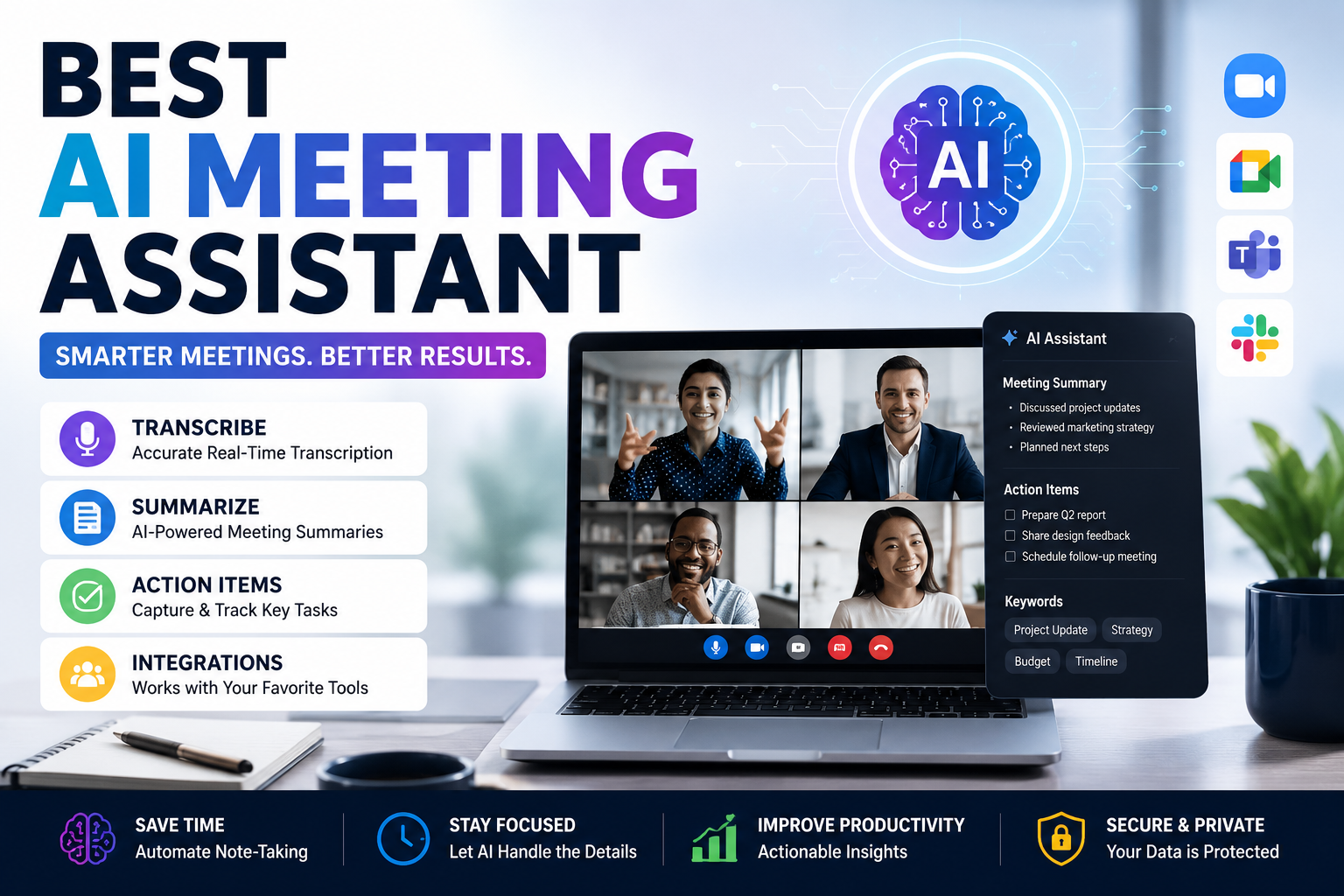
Which AI meeting assistant you choose ultimately depends on how you plan to use meeting transcripts. While there are many options, Fathom (unlimited recording at no cost), Granola (bot-free, notepad experience), Fireflies (for CRM-centric sales reps), Otter (for live captions, or face to face use) and tl;dv (for coaches and teams to capture timestamped video clips) can all be great fits. Most are built with common AI meeting summary features such as live transcription, summarization and action item extraction. What differentiates them most is the functionality they offer to turn meeting notes and records into actionable insights.
Why the Best AI Meeting Assistant Matters?
A meeting can churn out more information than a human can manage. Decisions are made, action items are assigned, context is developed – then most it vanishes as soon as the call ends. Our meeting assistant is here to fill that space. Listen into your calls (live or on recordings), transcribe your conversations and translate what goes into searchable action. Your meeting assistant turns your audio file into minutes, action plans, or a CRM entry that works.
By 2026, the category had divided into two types. “Note-takers.” – such as Granola, Otter, Fireflies, Fathom and Zoom AI Companion. They simply transcribe the discussion, summarize it, then throw the output back to you to address. “Agentic meeting platforms,” said Deans and his partners, – which perform all those functions too – and are designed “to pull key topics or requests that turn into tickets, documents, or follow-ups dynamically during the meeting. Offering these outcomes up to you as proposals rather than notes that you need to take on later.”
It’s not about selecting the “smartest” AI. it’s about sending the meeting output to the place it ought to end up-a shared dorsum, report into your CRM, task management record on a board, or the searchable company knowledge-and doing it consistently.
Best AI Meeting Assistant at a Glance
| Category | Details |
| Focus | Comparing AI meeting assistants by capture method, integrations, and where meeting output ends up |
| Primary Challenge | Choosing between bot-based vs. bot-free capture, and notetaking vs. agentic automation |
| Best For | Sales teams, remote/hybrid teams, solo professionals, and operations leaders managing high meeting volume |
| Reading Time | 9–11 minutes |
| Key Benefit | Less time spent on manual notes and follow-ups, more searchable institutional memory |
How AI Meeting Assistants Actually Work
While most AI meeting assistants offer a somewhat similar workflow.
Here’s what you’ll likely get:
- Join or attend – an actual avatar appears on your Zoom, Google Meet or Teams call or just passively listen by routing audio from your desktop. So your chatbot shows up on the invitee list or doesn’t.
- Transcribe – everything said is converted into a real time transcript including speaker identification.
- Summarize – a structured text summary that focuses on meeting outcomes. i.e., decisions made, action items created and what was discussed to get you there.
- Distribute and engage – sends out summary emails, populates shared doc, syncs with a CRM or other task management software (or for smarter ones: turns conversation to a draft ticket or follow up.
In the tools category comparison, we highlight the main things you should really be focused on method of capture (bot or no bot). What happens with the captured call data and the work left.
Bot-Based vs. Bot-Free Capture
In contrast to fireflies and Otter, which create a participant account to log into a chat and thenrecord and transcribeyour call. Most meeting-AI services simply introduce another account into your proceedings – a bot with access. This isn’t hidden – other people on the call “see” another meeting attendee. But it still can be an annoying gimmick if someone is being interviewed, and those types of private interactions can turn a meeting-AI’s default link-sharing and default AI-training modes to real Privacy-dilemmas.
For the above, bot-free options such as Granola records audio on your machine in real time instead. That does not send anything as a participant on the calls, which good should it be the situation that this data can only be transmitted for you taking records. Then which it does the work then: a kind of halfbreeds between the automated and also manual note-taker.
Notetakers vs. Agentic Platforms
A notetaker offers you meeting minutes and a summary. Then, you can import the action points into your tasks application, write a personalized email response. And physically add new leads or update existing ones in your customer relationships tool. An AI agentic platform automates the whole process, pushing call notes, suggesting responses and, action items at the close of the conversation or in real-time, for you to then authorize.
Agentic software was most recently introduced and tends to be a premium tool.
However, they prove to be a game-changer for busy teams that are overwhelmed by post-meeting administrative tasks.
Top AI Meeting Assistants Compared
1. Fathom — Best Free Plan
One of the most generous free offerings available, Fathom offers unlimited recordings, storage, and transcripts. But there’s a limit on the number of AI-generated summaries on the free plan. It plays nice with HubSpot, for auto-updates, and its “deal view” can roll up notes from several different sales calls with the same prospect. Making it a natural candidate for small sales teams seeking CRM integrations and auto-sync without a big check. Downside: you’ll have to forego a mobile app and the highly visible bot might be a distraction to prospects in your calls. Paid tiers cost about $16 per user monthly, to as much as $20 per user a month, depending on your plan.
2. Granola — Best Bot-Free Notepad
Granola runs on your computer and doesn’t appear in the call as a visible bot. Interleaving any notes you type with an AI-generated transcript summary. This human-in-the-loop setup generally yields tighter, more informative summaries than entirely automated systems-unless there’s a catch like “you have to be typing for this to work”. For solopreneurs and roles with a client facing element; attribution allegedly declines beyond 3 attendees on a call. And it favors those in the Google Workspace fold. The free tier caps meeting history before expanding to Business, a paid option with Notion and Slack integration and unlimited history, with an Enterprise tier just a step above with SSO and an array of admin features.
3. Fireflies — Best for CRM-Heavy Sales Teams
Fireflies injects a visible bot into the call and is fundamentally built around shoving your meeting structured data directly into your CRM. Support for HubSpot, Salesforce and others is built-in. They recently threw in some real-time coaching and an MCP server (which enables other AIs to pull conversation data) into the fold, broadening its role beyond basic transcribing. Teams focused on call quality via analytics are going to benefit most here. The visible bot feature could also prove problematic if participants on the receiving end have never encountered one.
4. Otter.ai — Best for Live Captioning and In-Person Meetings
Otter shines with real-time transcription and live captions. Perhaps the only tool on this list that transcribes in-person meetings with its smartphone app too. Otter connects to your Google Calendar and Zoom for seamless jumping-in. Free transcription minute allowances burn out faster for meeting attendees than it probably should, and Otter lags behind some competitors for accurately distinguishing between voices that sound like each other.
5. tl;dv — Best for Timestamped Clips and Security-Conscious Teams
Tl;dv’s core features – memorable clips that team members can easily search for and share (plus infinite meeting recording-even on the free plan) make this a solid choice when it is best to be able to look back at a specific snippet as opposed to scrolling through an entire meeting transcript. Tl;dv is geared as an enterprise option, complete with the assurances afforded to many recognized security organizations, which is necessary for meetings discussing sensitive topics involving clients.
6. Read AI — Best for Cross-Channel Context
Unlike merely recording a call, with Read AI you connect meeting outcomes with the relevant emails, chats, and even projects. Creating something more like a personal graph of knowledge than simply a collection of recordings. This is fantastic if someone, two months from now, needs to follow where an idea came from from multiple directions rather than solely remembering the single conversation that triggered it.
7. Zoom AI Companion — Best for Teams Already Standardized on Zoom
Built within your existing tools Zoom AI Companion is integrated directly into your already standard meeting platform. It’s the path of least resistance by adding meeting follow-ups. But don’t expect multiple platforms or highly robust CRM integration, at the expense of more configurable summaries.
How to Choose the Right AI Meeting Assistant
- Begin at your endpoint. If it needs to go to your CRM – Fireflies or Fathom (Fireflies for all major CRMs, Fathom for HubSpot). If you need a shareable team repository of searchable meeting notes – tl;dv or Read AI. If your endpoint is simply a beautifully organize personal notepad – Granola or Otter.
- Consider if an visible bot is ok For sensitive issues like hiring, speaking with customers or doing lawful interactions, a botless gadget is almost guaranteed in the pipeline to function as solution.
- Make sure to look for free tier limitations. As it varies to the extreme, one might offer X limited AI summary a month and other might offer your whole history of all meetings recorded over a lifetime.
- However, compare the above effort to a potential solution. What if your team spends many hours on top of meeting times to then take your action items and format them into a task, all while having to manually email follow-up questions to members? Then you may justify the price that is associated with agentic automation solutions.
- Do your platform compatible? There are a lot of the tools where the team is more Mac-centric, or a tool which requires a certain e-mail provider. Like Google workspace; in which the same will deny adoption if they start to have team-based-on-both.
Common Mistakes to Avoid
- Brand name over function Choosing based on brand alone rather than selecting a tool where your team works the follow-up.
- Overlooks permissions and privacy settings (like default “share link” or opt out settings for “train AI”). Which may pose a compliance issue when interacting with customers over the phone on sensitive matters.
- Using bot-based tools in customer calls or hiring calls without checking that people are okay with the visible AI bot.
- Free-tier users-those whose plans limit a certain number of minutes or events-don’t do due diligence in reading. What free is free and then find they hit the “ceiling,” as they would put it, two months into the quarter.
- I’ll go so far as to assume the note-taker would automate the decision of what “actually” deserves to become an action item – still takes a human being to know what’s important though.
- When you don’t factor in platform dependencies such as the need to be Mac-only (e.g. For creative apps) or tightly bound with your company’s use of G-Suite with mixed device team members.
Key Takeaways
- The AI meeting assistant category breaks down further into the following: – Note-takers – they transcript the conversation, then summarize the key take-awaypoints. – Agent-like platforms – can act on the conversation in real-time, or while the meeting itself is in progress.
- In Fathom’s price sheet, they currently promise what we think is the best free unlimited recording option and it should be noted here that Granola claims bot-free notepad capture.
- Fireflies tops CRM integration whereas Otter shines out when it comes to live captions.
- But that’s about the tradeoffs: Bot features feel very transparent but also quite intrusive on confidential calls, bot-free features are less intrusive but demand more human involvement.
- Free tier limit differences-there’s often difference in the amount you can use monthly, vs all lifetime of meetings kept.
- The better option will ultimately come down to where you expect to input the resulting meeting output, not which piece of technology theoretically has the greatest functionality.
Conclusion
None of them is the “best” AI meeting assistant. It’s the one that gets plugged into your workflow without missing a beat when the call’s done. Teams on calls to hit quotas will look to Fireflies or Fathom to keep the CRM populated, individual consultants and professionals working with customers may like Granola’s notepad feel without bots. While teams toggling between real and virtual call clients may feel a connection to Otter’s ability to caption live. Find where you want to store your notes, pick one or two candidates and run their free tiers for a week with actual meetings. Then-not before then- decide.
FAQs
1. Which is the best free AI meeting assistant?
For the best free tier, right now you’ll want to go with Fathom. It provides unlimited free recording, transcription and storage, but limits the number of meetings you get per month where an AI summary can be generated.
2. Can I use a AI meeting assistant on private calls?
This varies by tool – see if you can avoid retention policies, if you can opt out of AI training, or if the bot appears on the calls as a normal participant. While these bot-free tools seem more discreet for private conversations, the importance of its security certifications and controls is greater.
3. How is a notetaker different from an agentic meeting assistant?
A notetaker can generate a transcript and summary but you are still doing the follow-up work. An agentic meeting assistant takes the conversation, opens a ticket, prepares a draft document, or notes actions to be done and puts the output of all of these as a proposal that you can confirm.
4. Do they offer assistance for real-life meet-ups?
Yes, of course, and this is part of how many of AI assistants offer value – their in person functionality such as Otter with the real time app for meetings. Others don’t have an in person presence but work with the major video meeting tools of all shapes and sizes.
5. “Will it play well with my CRM?”
Many of the better options will. Both Fireflies and Fathom support integrations with popular CRMs like HubSpot and Salesforce, and can be a popular option for sales teams when call data is desired on the deal record.
6. Can I use theAImeeting assistant without a bot attending?
Yes- use tools such as Granola, that intercept the audio on yourdevice; instead of including a bot as aparticipant, to help keep informationconfidential, whether with customers orinternalaudit trails.
7. What does an AI meeting assistant generally cost?
The majority typically start free (with usage restrictions) but range to anywhere around $10-$40 per user per month for the better software. But there is a higher cost for more enterprise focused solutions that may come with admin management, single sign-on (SSO), and API access for your business.