

Introduction
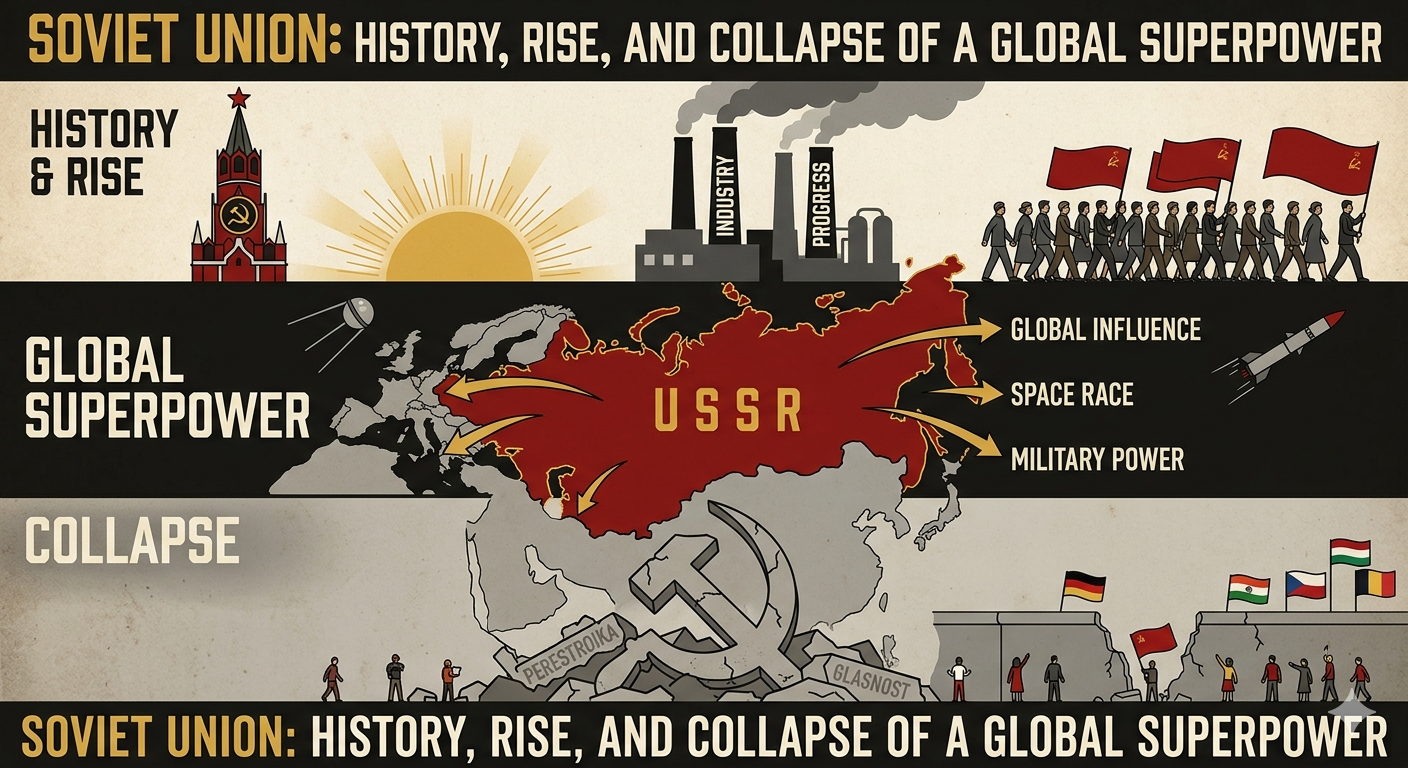
The Soviet Union developed into a powerful nation which significantly impacted 20th century historical events. The Soviet Union operated as a global power from 1922 until 1991 because it exercised total control over all economic activities and military operations which occurred outside its borders. Scholars and students continue to study the Soviet Union as a historical subject because they research its revolutionary developments which lasted until the regime’s final collapse.
Formation of the Soviet Union
The Russian Revolution established the Soviet Union which put an end to the Tzarist monarchy that had ruled for many centuries. The revolution established Communist rule through the leadership of Vladimir Lenin.
The Soviet Union first emerged as a unified nation in 1922 when several republics formed a single national entity. The government created a system which would establish a society without class distinctions while sharing all resources equally among its citizens. The state operated all political and economic systems because it owned all power throughout the country.
Rise as a Global Superpower
Stalin established complete state control over the Soviet Union when he became leader after Lenin’s death. The USSR reached global superpower status because it achieved rapid industrial expansion and developed collective farming systems.
The Soviet Union played a critical role in World War II because it helped to defeat Nazi Germany. The victory extended the country’s political power base and brought it more international recognition. The USSR emerged as one of the two superpowers who fought against the United States after World War II ended.
The Cold War Era
The Cold War developed between the Soviet Union and the United States as both superpowers engaged in an extended period of military and diplomatic conflict. The two nations engaged in a competition which focused on developing nuclear weapons and space technology and establishing international power though they never fought a major war against each other.
The Soviet Union led the Eastern Bloc spreading communism to countries in Eastern Europe while the United States promoted capitalism in the West. The Berlin Wall and the Cuban Missile Crisis represented two major events which demonstrated the worldwide struggle for power that existed between these two countries.
Life in the Soviet Union
During the Soviet Union period people created a unique way of life which differed from everything found in Western countries. The government controlled all daily activities which included work and school and news distribution. The citizens received free healthcare and education services yet the government censorship imposed severe restrictions on their personal rights.
People faced economic difficulties at every stage of their existence. Basic needs became accessible to people yet they encountered challenges because of inadequate product availability and insufficient living conditions. The USSR accomplished major scientific and technological breakthroughs through the launch of Yuri Gagarin the first human to travel into outer space.
Collapse of the Soviet Union
The Soviet Union began its decline during the 1980s because of its weak economy and corrupt political system and increasing public discontent. Mikhail Gorbachev introduced glasnost which means openness and perestroika which means restructuring to achieve his goal of system improvements.
The changes which occurred in the system resulted in its full elimination from existence. The 1991 dissolution of the Soviet Union occurred when its republics declared independence which marked the end of an entire historic period. Russia emerged as the primary successor state which assumed responsibility for the Soviet Union’s governmental duties.
Legacy of the Soviet Union
The Soviet Union’s legacy continues to shape political developments and historical occurrences in various regions worldwide. The Cold War period became highly influential because it established major international relations frameworks that shaped global diplomatic systems. The rise and decline of empires shows how different political systems and economic systems operate within their respective governance frameworks.
The historical record of the Soviet Union provides historians with information about how communism affected society and how authoritarian governments threaten democracy and how superpower nations engage in international power struggles.
Conclusion
The Soviet Union emerged as a dominant global power which created all current global challenges. The Soviet Union historical record contains essential events and notable individuals and significant occurrences which shaped its future development.
Our current political environment benefits from Soviet Union understanding because it provides political context and historical knowledge.