

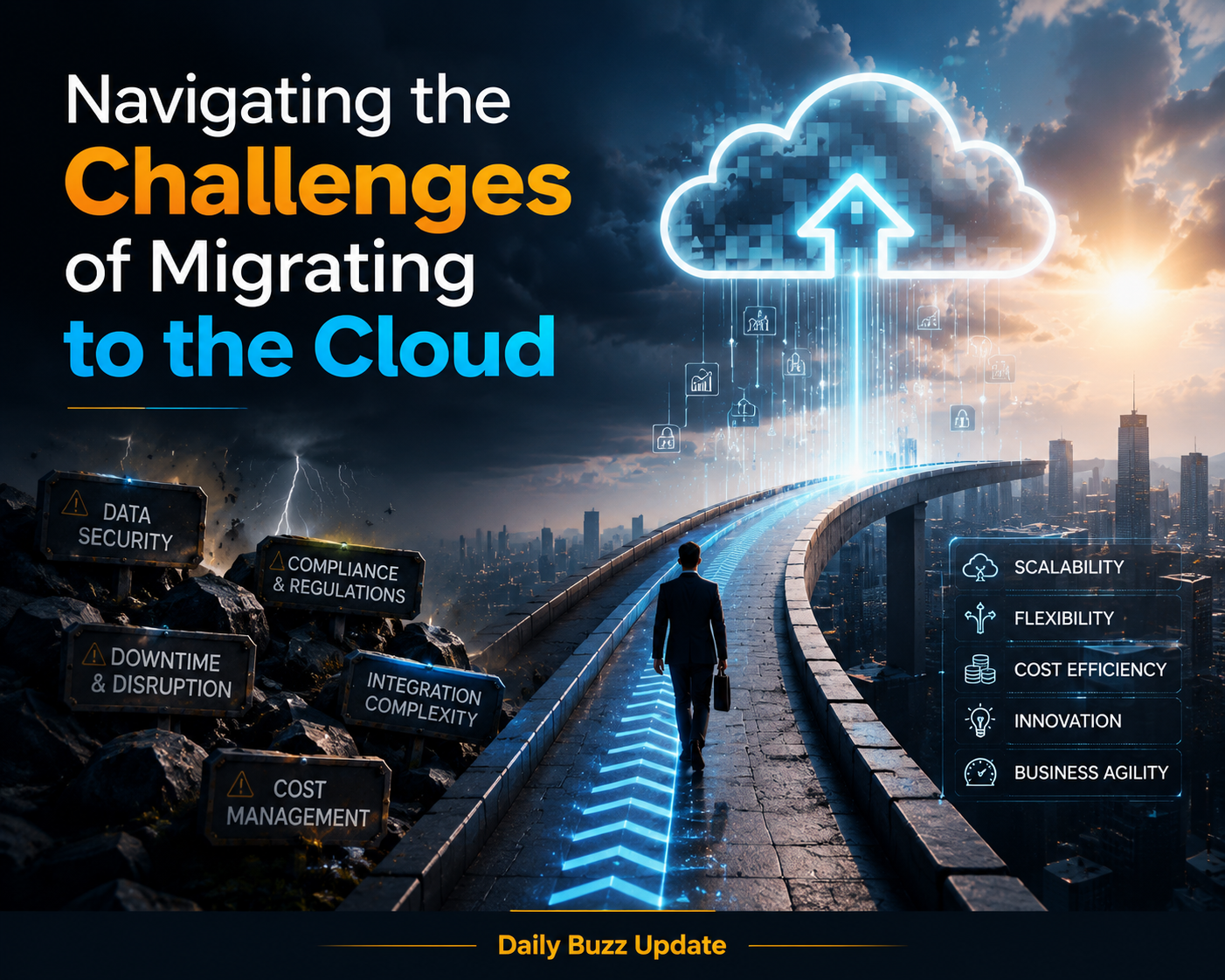
Quick Answer: Cloud migration challenges include data security risks, legacy system compatibility, unexpected costs, downtime, compliance requirements, and choosing the right migration strategy. Businesses can overcome these challenges through careful planning, security best practices, employee training, and continuous performance monitoring.
Why Cloud Migration Matters
Cloud migration allows organizations to improve scalability, strengthen security, reduce infrastructure costs, and support digital transformation. Businesses that successfully overcome cloud migration challenges are better positioned to innovate, adapt to changing market demands, and deliver reliable digital services.
Introduction
Cloud computing has transformed the backbone of today’s digital landscape, allowing organizations to scale at a rapid pace, improve business efficiency, and drive cost savings for their infrastructure. But it doesn’t just mean you pick up your applications, databases, and workloads and migrate them over the cloud; it also requires careful consideration of security risks, hidden cost implications, incompatibility problems, as well as downtime.
Any business considering the move of systems, applications, or data to the cloud needs to understand the common challenges they will face.
A successful migration involves strategic planning, selection of appropriate technology solutions, and a focus on security, performance, and overall business goals. In this article, we will cover the most common cloud migration challenges and suggest ways to resolve them.
At a Glance Table
| Topic | Details |
|---|---|
| Focus | Cloud Migration |
| Primary Challenge | Security, Cost & Legacy Systems |
| Best For | Businesses, IT Teams & Decision Makers |
| Estimated Reading Time | 8–10 Minutes |
| Key Benefit | Safer & More Efficient Cloud Migration |

What Is Cloud Migration?
Cloud migration is the practice of transferring digital resources such as applications, data, databases, workloads, and servers from on-premises systems to the cloud, and even from one cloud provider to another.
There are several models of cloud adopted by businesses to support different operational requirements:
- Public Cloud: Services offered by providers like Amazon Web Services (AWS), Microsoft Azure, and Google Cloud.
- Private Cloud: A dedicated cloud environment designed for a single organization.
- Hybrid Cloud: A combination of on-premises systems, private cloud, and public cloud services.
- Multi-Cloud: Using services from multiple cloud providers to improve flexibility and reduce dependency on a single vendor.
While each solution provides its benefits, each one creates different operational and technical concerns.
Why Businesses Are Moving to the Cloud
The value of cloud technology is why businesses across all sectors keep investing in the new trend.
Improved Scalability
Businesses scale their computer resources up and down based on demand. That means you have the flexibility of accommodating a sudden increase in traffic without spending a fortune on your physical hardware resources.
Cost Optimization
Businesses can move from the costly investment and maintenance of hardware to pay for what they use as they consume it.
Better Collaboration
Files, tools, and systems in cloud-based software allow individuals around the world to log in and gain access regardless of location-which makes it convenient for businesses looking to encourage remote workers and a global presence.
Faster Innovation
Cloud services offer you access to such complex technologies as AI, ML, analytics, and automation tools, which help you innovate faster. However, most businesses don’t have a clear idea about the complexity involved in the process of migration.
This is the point at which understanding of cloud migration challenges becomes important.
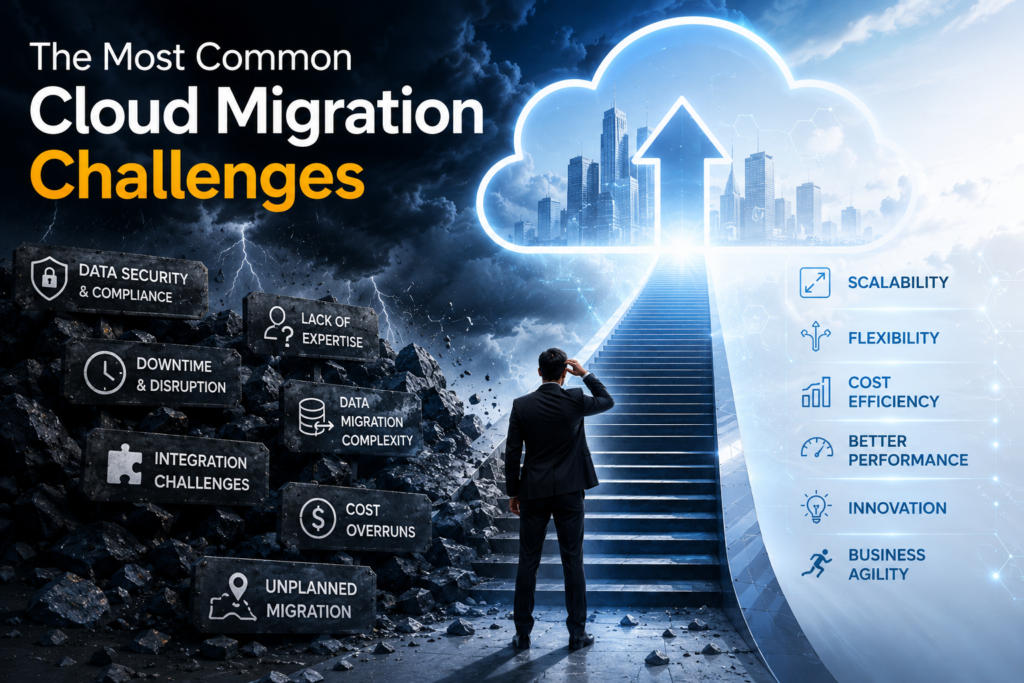
The Most Common Cloud Migration Challenges
1. Lack of a Clear Migration Strategy
One of the most common cloud migration pitfalls is to simply dive into the migration process without a road map. While many companies make a migration to reduce expenses, for instance, or to update technology infrastructure, a lack of goals can make projects go by the wayside.
Any well-planned migration effort includes:
- Business goals and expected outcomes
- Applications to be migrated
- Migration timeline and milestones
- Budget requirements
- Risk management plans
- Performance metrics
To prevent this, the need for having well-structured and detailed plans is important because otherwise companies can expect cost increases, some unexpected problems, and the operational process can be delayed.
2. Data Security and Compliance Risks
Security: One of the greatest fears surrounding adoption of the cloud Security is and continues to be at the forefront when it comes to adoption of the cloud.
When businesses and organizations begin to migrate data into the cloud, they place information at risk without adequate security controls to protect that sensitive data.
Businesses operating in the healthcare, financiala nd government sectors must be acutely aware of government standards for data protection and privacy.
Critical Security Aspects include:
- Data encryption during transfer and storage
- Identity and access management (IAM)
- Multi-factor authentication (MFA)
- Regular security audits
- Compliance with standards such as GDPR, HIPAA, or ISO certifications
If these problems are dealt with upfront, you will avoid a huge amount of risk and will build trust with clients and interested parties.
3. Legacy System Compatibility
Many companies still run existing, on-premises software that predates cloud computing. The problem, in this case, is that the system must be drastically modified, re-architected, or entirely replaced before it works correctly in the cloud.
The most common challenges you may see are:
- Unsupported software dependencies
- Incompatible databases
- Performance limitations
- High modernization costs
By evaluating your current applications before migration, you are able to figure out which applications should be rehosted, refactored, re-platformed, or abandoned.
4. Unexpected Costs
Cloud migration problems are rarely discussed in terms of cost. If the transition to the cloud may help you to lower your infrastructure expenses, an uncoordinated migration might bring about unintended costs for data transfer, space utilization, licensing, and resource utilization too.
The following measures will be useful to you to prevent spending more on cloud resources than planned:
- Conduct a detailed cost analysis before migration
- Monitor resource usage continuously
- Use cloud cost management tools
- Optimize workloads after migration
- Eliminate unused resources
A proactive posture on cost management is key to making your cloud investment have sustainable value.
5. Downtime and Business Disruption
Businesses may face interruptions to their usual activities with app and data migrations ifit’s not performed carefully.
A migration not being performed correctly and causing a company downtime can cause loss of productive output, loss of client satisfaction, and decreased revenue, which for businesses available around the clock becomes problematic.
The proper measures to reduce downtime include:
- Migrate in phases rather than all at once
- Test workloads in a staging environment
- Create backup and disaster recovery plans
- Schedule migrations during low-traffic periods
- Communicate changes to employees and stakeholders
You can drastically lower operational risk by being smart and thoroughly testing during your migration.
Why a Risk Assessment Is Essential
Any company considering a move to the cloud should begin by conducting a thorough risk assessment and analysis to determine any potential financial, technical, and security issues that may exist.
Such an analysis can help to answer crucial questions like:
- Which applications are cloud-ready?
- What data requires additional protection?
- What are the potential compliance requirements?
- How much downtime can the business tolerate?
- Which migration approach is most suitable?
By recognizing potential risks ahead of time, the organization can develop a plan that takes its business needs into account to prevent costly surprises.
In the subsequent post, we will discuss in greater depth how to manage the risks involved with cloud migration, select the correct cloud migration strategy and best practices, and select your cloud provider.
Proven Strategies to Overcome Cloud Migration Challenges
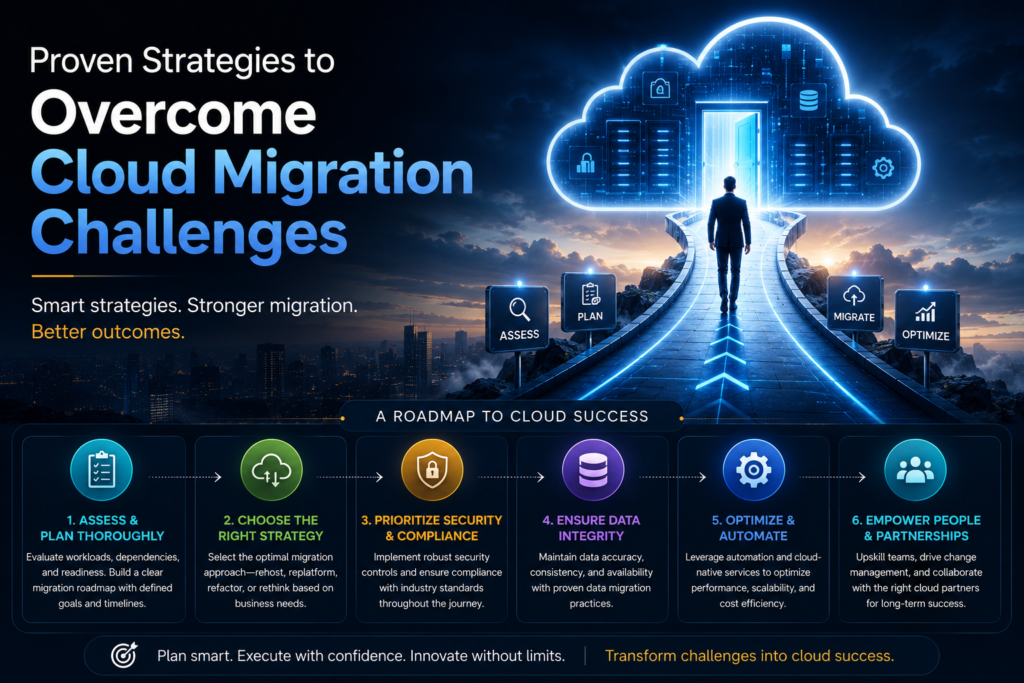
To make cloud migration a success, it takes more than moving files and apps to cloud servers. The highest-achieving organizations implement a migration plan before migrating, conduct a risk assessment, and monitor ongoing performance after deployment.
Here are some of the effective approaches companies can use to overcome the most-frequently seen cloud migration challenges, to curb costs while limiting business operational risks.
Choose the Right Cloud Migration Strategy
The approach for every app does not need to be the same. The selection of the migration strategy depends on various factors such as existing setup, your business objectives, the cost involved, and the desired output.
Here are some of the commonly used approaches to migration:
Rehosting (Lift and Shift)
Rehosting: It means moving the applications into the cloud without many changes. This is one of the fastest migration processes and is ideal for those companies that require moving the application quickly without the need to re-design it.
Replatforming
Businesses modify their applications slightly before shifting to the cloud during replatforming. The practice enhances performance by not undertaking a complete redesign.
Refactoring
Refactoring redesigns apps specifically for the cloud. This takes time and upfront cost, but allows companies to leverage cloud-native functionalities including containerization, auto-scaling, and microservices.
Retiring or Replacing Applications
Existing legacy applications no longer make sense from a business point of view, and instead of simply moving obsolete applications to the cloud, you can make decisions like leaving it obsolete, moving it to retirement, or replacing it with modern alternatives in the cloud.
Choosing one or the other strategy for each workload can mitigate the problem of technical difficulties.
Build a Skilled Cloud Team
Having the right technology isn’t enough for successful migration. We need humans too… Migrations fail because organizations’ IT departments often lack expertise in areas like cloud architecture, automation, or cloud security.
Training staff for a cloud migration goes a long way, though:
It should empower them to know…
- Cloud infrastructure
- Identity and access management
- Security best practices
- Networking concepts
- Disaster recovery planning
- Cloud monitoring tools
Or, those with insufficient in-house know-how can leverage external expertise from skilled cloud consultants or managed service providers.
Prioritize Security From the Beginning
Cloud migration is no different – never make security an add-on. You need security considerations at the top of the list throughout the whole cloud migration process, and it’s no different from making cloud-safe choices.
Here are the recommendations.
- Encrypt sensitive data during migration.
- Apply role-based access controls.
- Enable multi-factor authentication.
- Monitor user activity continuously.
- Conduct regular vulnerability assessments.
- Keep software and operating systems updated.
Businesses that have a proactive security approach minimize their chances of getting data breached. Proactive security ensures that organizations adhere to various industry compliance regulations.
Test Before Full Deployment
Pilot testing has proven to be one of the most successful methods of minimizing cloud migration problems.
Organizations that embark on cloud migration projects often test the process with less critical, non-mission-critical workloads.
Testing proves the following:
- Application compatibility
- Performance under real workloads
- Network latency
- Security configurations
- Backup and recovery procedures
Finding errors while testing is much cheaper than after it has been widely deployed.
Monitor Performance After Migration
Migration is not over once your apps are running in the cloud. Continuous monitoring of performance, costs, and security issues allows organizations to proactively mitigate business impacts and prevent potential business disruptions.
Key areas to monitor include:
- Resource utilization
- Application response times
- Storage usage
- Network performance
- Error rates
- Cloud spending
Routine inspections keep cloud infrastructure running efficiently.
Choosing the Right Cloud Provider
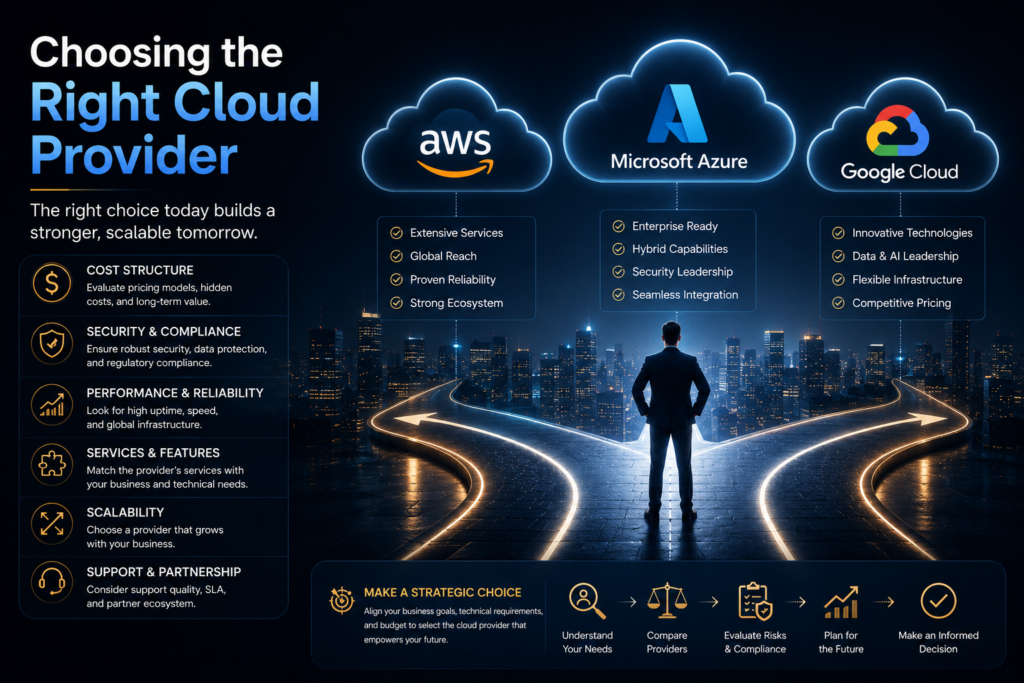
The choice of a cloud provider will undoubtedly be one of the most crucial decisions throughout a migration project.
The evaluation process by business organizations should consider:
- Reliability and uptime
- Global infrastructure
- Security certifications
- Compliance support
- Pricing structure
- Scalability
- Technical support
- Disaster recovery capabilities
So instead of merely being influenced by the cheapest bid, consider opting for a vendor that supports your long-term business objectives, along with your technical and financial requirements.
Common Mistakes to Avoid
Even good migration strategies can have difficulties when organizations make fundamental mistakes.
The most frequent mistakes include:
- Migrating without a detailed roadmap.
- Ignoring application dependencies.
- Underestimating migration costs.
- Skipping performance testing.
- Failing to train employees.
- Neglecting cybersecurity measures.
- Moving every workload without evaluation.
- Overlooking post-migration optimization.
Learning to avoid these mistakes could not only make you a ton of cash but also save you a hell of a lot of time, money, and effort.
Future Trends in Cloud Migration
The adoption and use of cloud are growing exponentially; cloud migration strategies are becoming complex.
Here are a few trends shaping cloud:
- Artificial intelligence for workload optimization.
- Automated migration tools.
- Hybrid and multi-cloud environments.
- Serverless computing.
- Edge computing integration.
- Stronger cybersecurity automation.
- Predictive cloud cost management.
Businesses that are aware of these shifts and changes will be well prepared to respond.
Best Practices for a Successful Cloud Migration
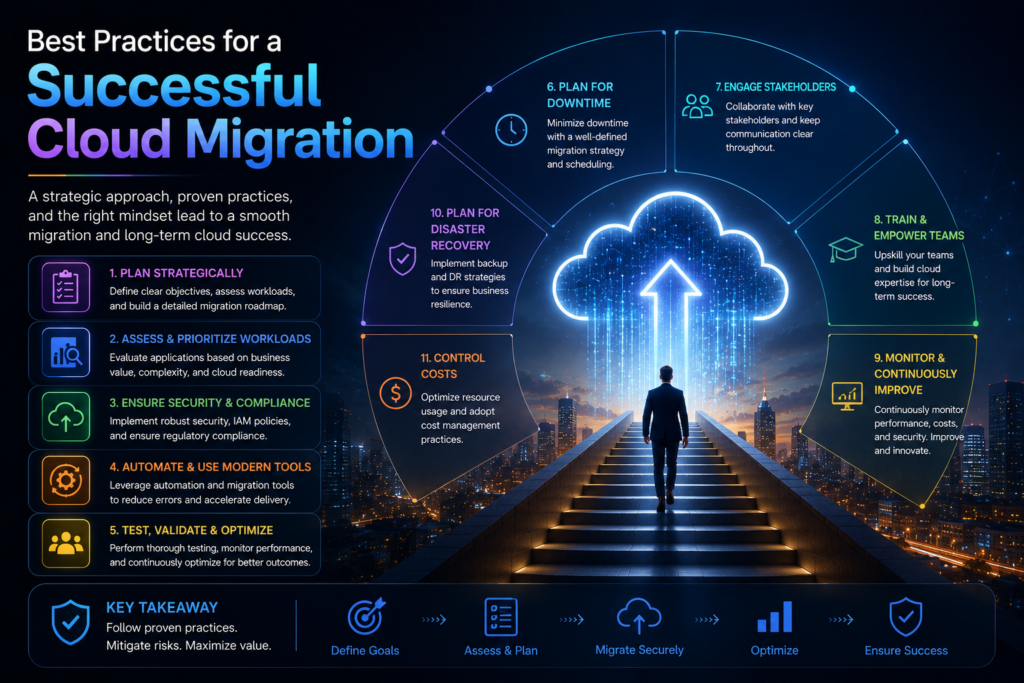
The specifics of a cloud migration project will vary depending on your organization, but success typically boils down to a few best practices.
Organizations that excel at cloud migration: plan meticulously, bring all key stakeholders into the fold, and make continuous improvements to their cloud footprint.
Plan for a smoother cloud migration by:
- Define clear business objectives before moving workloads.
- Assess applications to determine the best migration strategy.
- Back up critical data before migration begins.
- Train employees on new cloud technologies.
- Monitor security and compliance throughout the process.
- Optimize cloud resources regularly to control costs.
- Review performance metrics and make improvements over time.
By implementing these practices, companies can minimize the potential pitfalls of the cloud and make the most out of this transformative technology over the long run.
Why Cloud Migration Is Worth the Investment
In short, while businesses will run into some hiccups during their cloud journey, the return on investment will typically outweigh the difficulties.
In the long run, cloud migration can empower a business to move at a faster pace, improve cybersecurity and protection, enable remote workers to connect seamlessly and securely, trim IT spending, and enhance operational agility to meet market demand.
Since the evolution of cloud technologies isn’t going to slow down anytime soon, businesses that adopt new infrastructure now will be better positioned to leverage disruptive new technologies such as AI, machine learning, advanced data analytics, and more in the future.
Key Takeaways
- Cloud migration requires careful planning before moving workloads.
- Security and compliance should be prioritized throughout the migration process.
- Legacy applications may need modernization before cloud deployment.
- Monitoring costs helps prevent unexpected cloud expenses.
- Testing workloads before deployment minimizes downtime and business disruption.
- Choosing the right migration strategy improves long-term success.
- Continuous optimization ensures better cloud performance after migration.
Common Mistakes to Avoid
- Migrating without a clear roadmap.
- Ignoring data security requirements.
- Underestimating migration costs.
- Skipping testing before deployment.
- Moving all workloads at once.
- Not training employees.
- Failing to monitor cloud performance after migration.
Conclusion
Moving to the cloud is a major technological transition, not a single, stand-alone project, but one that should be approached strategically from a business perspective. Despite potential security issues, integrating with legacy systems, unanticipated costs, and extended downtime during cloud migration, these can be addressed through sound planning and the right cloud migration plan. Companies that evaluate their current infrastructure, use expert personnel for cloud migration, address security as a priority, and monitor performance post-deployment will have greater success.
Migrating to the cloud should be looked at as a continued, ongoing process of optimization rather than a single, discrete project.
Understanding the primary cloud migration challenges and implementing effective best practices can ensure businesses can leverage the power of cloud technology, minimize their risk, and optimize their operations in the long term.
Frequently Asked Questions
What are the biggest cloud migration challenges?
Here are the biggest cloud migration problems, by frequency of complaint, ranging from data breaches and incompatibility with legacy systems to costs running over, downtime, and a lack of a proper plan.
Why do businesses migrate to the cloud?
These are the top 5 reasons businesses make the jump to cloud: enhanced scalability, better cost reduction, increased flexibility, better teamwork, and more robust features.
How can organizations reduce cloud migration risks?
Companies could minimize their cloud migration risks by having a solid migration plan in place, conducting a thorough risk assessment, testing applications before implementation, and implementing robust security measures with ongoing monitoring of cloud operations.
Which cloud migration strategy is best?
Your best strategy, though, relies on what your company is trying to achieve and your current technology footprint. Usually it includes rehosting, replatforming, refactoring, and sometimes even rewriting.
Is cloud migration suitable for small businesses?
Definitely! Yes, Small Businesses Can Get More from the cloud to reduce IT spending, increase their scalability, simplify communication, and access sophisticated enterprise technology without paying exorbitant prices to own everything physically on their premise.